This Sunday, You Will Reject Everything Jesus Says in This Gospel — At First


The life of faith is the greatest, most exhilarating life in the world. Sometimes. Other times it is the most tedious, thankless life in the world.
It’s supposed to be that way. The Church explains why in Sunday’s readings, the Twenty-Seventh Sunday in Ordinary Time, Year C.
Here are six takeaways drawn from Sunday Readings columns at this site and the Extraordinary Story podcast.
First, a warning: You may not believe anything Jesus has to say, at first.
First, he says, “If you have faith the size of a mustard seed, you would say to this mulberry tree, ‘Be uprooted and planted in the sea,’ and it would obey you.”
Um — I don’t know about you, but I can’t do that, and I have never known anyone who can. Does that mean we don’t have even a smidgeon of faith?
Second, he says, “Who among you would say to your servant who has just come in from plowing or tending sheep in the field, ‘Come here immediately and take your place at table’?”
Again, I think most people I know would be happy to give someone a dinner break after hard work in the field. And I am not sure who I know who would give what Jesus says is the expected response to such a servant:
“Prepare something for me to eat. Put on your apron and wait on me while I eat and drink. You may eat and drink when I am finished.”
Second: But think again and what Jesus says makes a lot of sense. Take the mustard seed first.
I love St. Thérèse of Lisieux’s take on the mustard seed. She wrote, “for a soul whose faith equals but a tiny grain of mustard seed, God works miracles, in order that this faith which is so weak may be fortified; yet for his intimate friends, for his Mother, he did not work miracles until he had put their faith to test.”
In other words, according to her, Jesus is not saying, “any amount of faith can do miracles.” He is saying, “God is willing to do miracles in order to convince those who are just finding their faith.”
That’s not the usual way that passage is interpreted, but she’s a Doctor of the Church, and it does make sense. If we think back on the early days of our faith, we can remember those kinds of miracles: Obstacles disappeared for us, heaven and earth moved to help us, and we were showered with spiritual favors.
But then, if you think about it, maybe our mature faith does wonders too.
Jesus said faith can uproot mulberry trees and plant them in the sea. My life has had many deep-rooted problems in relationships that seemed unfixable, addictions I thought would grip my life forever, and character defects I was certain would lead to failure. Slowly and steadily, faith has straightened out those relationships, unloosened those addictions, and overwhelmed my defects with grace.
Third: As to the treatment of servants, Jesus truly describes our lives again.
We think we wouldn’t tell our tired servants to wait on us, but we probably did exactly that the last time we went to a restaurant and expected quick, cheerful service from a waitress without caring what kind of day she was having.
Or maybe we were the servant he is describing the last time we came home from the office and had to take kids to soccer, run to the bank, fix the faucet, sort out the bills, make dinner, switch the laundry, and answer an overdue work email somehow in the middle of it all.
We don’t expect an award for any of it, because we know that our job and our family are worth it. Jesus is simply asking, “Now, how about me? Am I worth it, too?”
Our actions say to our families, “We are unprofitable servants; we have done what we were obliged to do.” Can we say that to Our Lord, also?
Fourth: St. Paul tells Timothy how this works.
“Stir into flame the gift of God,” he says in the Second Reading. Other translations say “fan into flame the gift of God.”
The idea is the same: Stir the dying embers of your faith to get a flicker of flame started. Feed the flicker with enough oxygen to grow it bit by bit into a blaze.
“It is in our power to kindle or extinguish this grace,” St. John Chrysostom said about this passage, “As fire requires fuel, so grace requires our diligence, that it may be ever fervent … By sloth and carelessness it is quenched, and by watchfulness and diligence it is kept alive.”
St. Paul describes how to be diligent: “God did not give us a spirit of cowardice but rather of power and love and self-control. Do not be ashamed of your testimony in the Lord … but bear your share of hardship for the Gospel with the strength that comes from God.”
In your pursuit of the faith, don’t be afraid, don’t be indifferent, and don’t give up. After you have done your duty to God, do more for God. After you have prayed, serve. After you have served, study. After you have studied, pray more.
Fifth: This Sunday we get a great example of what mustard seed faith looks like.
Don’t forget that the whole mustard seed analogy comes in answer to a request of the disciples at the beginning of the Gospel: “Lord, increase my faith.”
St. Augustine once pointed out what a mustard seed is most known for. “Nothing is stronger to the taste,” he said. “What does that signify but the very great fervor of inner strength of faith in the Church?”
A mustard-seed faith stubbornly believes in Jesus’s promise, even in the face of long odds. It’s the kind of faith Habakkuk has in the First Reading.
His faith has been stretched to the breaking point by the disaster he sees around him. Fed up with the pain, he says, “How long, O LORD? I cry for help but you do not listen! I cry out to you, ‘Violence!’ but you do not intervene. Why do you let me see ruin; why must I look at misery?”
That is the kind of prayer God likes: a brutally honest prayer that calls God’s bluff. We should pray the same way: “Okay. You’re king of the universe and the Lord of my life. I believe it. So why is your universe so messed up and why has my life gone so wrong?”
God’s answer will be the same one he gave Habakkuk.
“Write down the vision clearly upon the tablets, so that one can read it readily. For the vision still has its time, presses on to fulfillment, and will not disappoint. If it delays, wait for it, it will surely come, it will not be late. … The just one, because of his faith, shall live.”
The message: Keep believing, and you will be glad you did. One day, the tree that has sunk its roots into your life will be drowned in a sea of his mercy. Keep doing your duty like an unworthy servant, and God will raise you to the heights.
Sixth: Because our God is the God of glory and the God of the grind.
When life is hard, remember the days when your faith moved mountains. And when life is glorious, rededicate yourself to a hard slog of real action.
Jesus shows us both in the celebration of the Eucharist this Sunday. There, a single round host is elevated above the altar like a mustard seed, and this small thing is declared to be the center of the universe as the priest prays: “All glory and honor is yours, for ever and ever.”
After that, the Lord treats his servants the way we least expect to be treated. At communion, he says, “Come here immediately and take your place at table,” and we walk toward the altar, where he personally serves us something to eat — his very body, blood, soul and divinity.
He comes to give us a faith that changes everything.
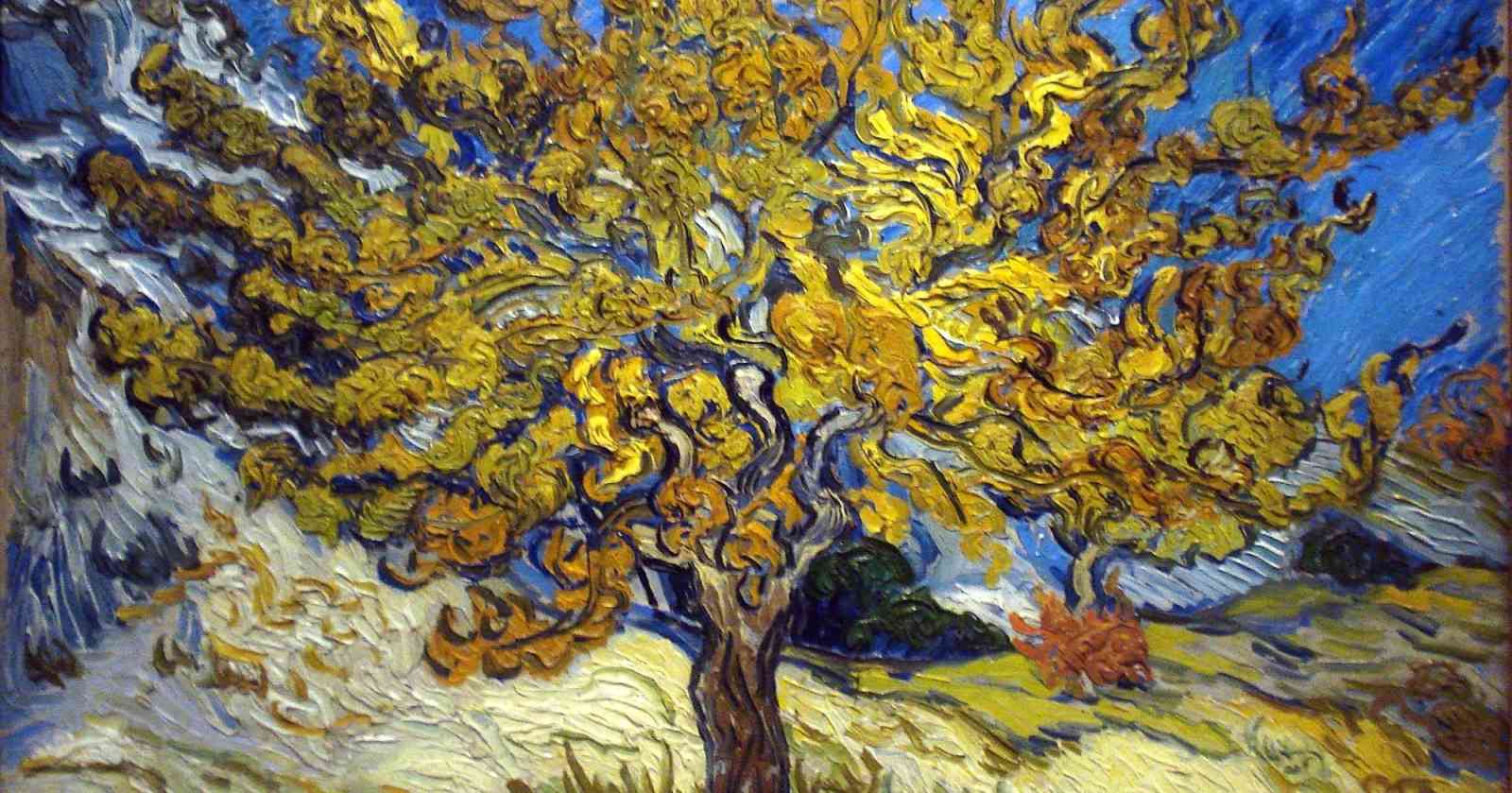
Image: The Mulberry Tree by Van Gogh, wikimedia
By Tom Hoopes
Dear Reader,

Would you like to better understand the spiritual depth and daily insights of Jesus' parables?
We'd like to offer you our FREE video series, Christ the Storyteller. Each episode of this series will help you experience the profound truths Jesus conveys in each parable.
In 10 short lectures, Dr. Andrew Swafford, Professor of Theology, dwells on a different parable—revealing their theological meaning, spiritual insight, and practical guidance for everyday Catholic living.
Start your FREE video series today and explore the practical wisdom of Jesus’ Parables!
Receive My Free Video Series »