This Sunday, We Each Meet the Lamb of God Who Changes Everything


John the Baptist tells us that he has been told that Jesus Christ is the Lamb of God, and that we can expect the Holy Spirit. In other words, at the Father’s command we become one with the Son with the Spirit, and enter into the life of the Trinity. This changes everything for Christians.
Here are five takeaways for the Second Sunday in Ordinary Time Year A, drawn from Sunday Readings columns at this site and the Extraordinary Story podcast.
First: John’s surprising words transform the expectations of his listeners.
In Advent, the Gospels focused on John the Baptist telling us to expect someone mighty and greater than him, someone who would transform the world. He described him coming like a great enforcer who would put his axe to the root of trees that don’t bear fruit, or like an angry fire that would burn up the useless chaff of corrupt, wasted lives.
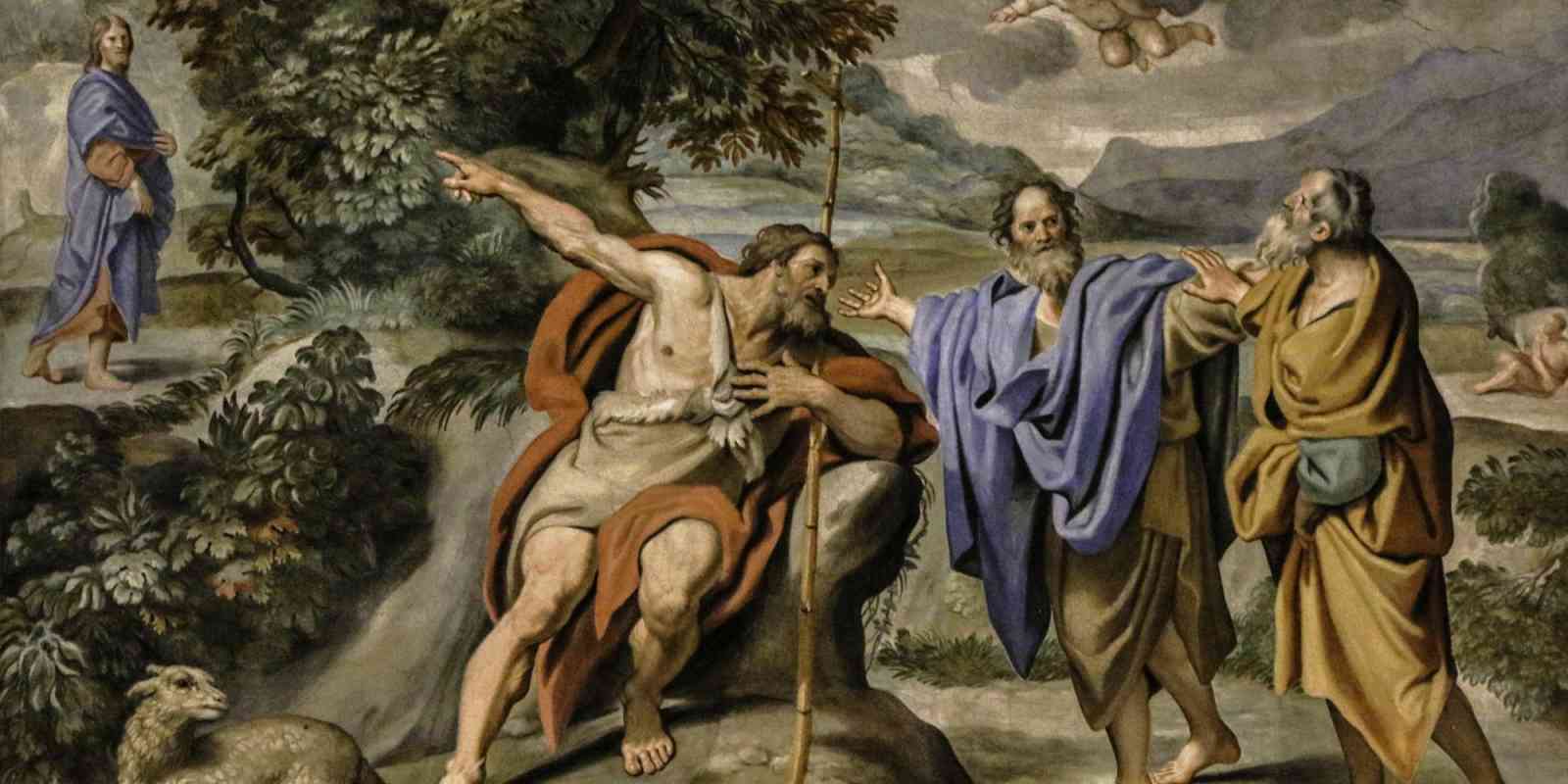
Now he shows up, and he is no longer a mighty hero with an axe, or a furnace of judgement. Instead, John sees Jesus coming toward him and says: “Behold, the Lamb of God, who takes away the sin of the world.”
This is a big surprise. “Taking away the sins of the world” was not front of mind to Jews waiting for the Messiah. They expected other kinds of healing and victory, but not that. In fact, when Jesus does begin “taking away the sins in the world” he is immediately confronted by the opposition of Jewish leaders who tell him that only God can do that.
Announcing God cas a lamb feels wrong, as if King Saul fighting the Philistines was warned of a mighty warrior coming, but then, instead of a giant, a puppy named Goliath came over the hill.
But of course a lamb meant a lot more than just an animal to the minds of the Jewish people. They would remember Jeremaiah Chapter 10, and how God’s chosen would be like a “gentle lamb led to the slaughter.” They would also remember the prophecies in Isaiah Chapter 53 of this lamb led to the slaughter is also the Suffering Servant who was “numbered with the sinners, yet bore the sin of many.” Above all, they would think of the Passover lambs that saved the Israelites from death and freed them from slavery.
But John identifies Jesus as more than just the “Lamb of God.”
Second: John also points to the Holy Spirit’s entrance into the world in a new way.
This reading is from the same Gospel that calls John more than a prophet — he is one who “witnesses to the light.”
Here we see exactly what that means. He says God told him “On whomever you see the Spirit come down and remain, he is the one who will baptize with the Holy Spirit.” Then he identifies Jesus as the One.
This is a remarkable moment, in which the Trinity, which had previously been revealed to Mary by an angel, is revealed to the whole world by John. He says:
“The one who sent me to baptize with water told me, ‘On whomever you see the Spirit come down and remain, he is the one who will baptize with the Holy Spirit.’ Now I have seen and testified that he is the Son of God.”
Look at God’s actions as described here by John: God the Father spoke to John and showed him the Holy Spirit, so he announced the Son of God. This is something new in salvation history: a prophet who not only gets messages and cryptic images from God’s point of view, but one who is on intimate terms with God’s interior life.
And he is not the last to have this relationship with God; he is the first. John identifies Jesus as “the one who will baptize with the Holy Spirit.” He is the one who will give all of us what John has.
Third: St. Paul tells us John was right.
We are already living the life in the Spirit that John the Baptist predicts. That’s the meaning of the strange reading from St. Paul, which is essentially just the first line of a letter. It reveals the essence of what it means to be Christian. Being Christian means to be “sanctified in Christ Jesus, called to be holy, with all those everywhere who call upon the name of our Lord Jesus Christ.”
It often seems like we are falling far short of the high-sounding status of a Christian. But the life that John and Paul are describing is not a summit we have to strain to reach — it’s the ground from which we start.
So, just as we prepared in Advent for Christmas by living our Christian life more deeply in Christ, we can spend Ordinary Time living our relationship with the Holy Spirit more deeply. The Church teaches us that this relationship starts with Baptism, when we are given the fruits of the Holy Spirit:
- peace, joy, and love in our hearts;
- kindness, patience, and generosity with the world;
- gentleness, faithfulness, and chastity in our relationships; and
- modesty, goodness, and self-control in our interior lives.
Fourth: But ultimately, the Christian life doesn’t exist merely to deliver personal happiness or emotional peace.
We are given the Holy Spirit not just for ourselves, but for the whole world. in the First Reading we hear:
“It is too little, the LORD says, for you to be my servant, to raise up the tribes of Jacob, and restore the survivors of Israel; I will make you a light to the nations, that my salvation may reach to the ends of the earth.”
We might translate that: “It is too little for you to gather around me and enjoy what I offer. You must broaden the circle to include more and more.”
The Psalm describes how this works. First comes the recognition that we need a savior: “I have waited, waited for the Lord, and he stooped toward me,” it says. Then we need openness to receive a savior: “Sacrifice or offering you wished not, but ears open to obedience you gave me,” it says. Finally, we can respond: “Here am I, Lord; I come to do your will …. to do your will, O my God, is my delight.”
The Psalm says we are able to do his will because “your law is within my heart!” What that means is that we have the seven gifts of the Holy Spirit, permanent dispositions which make us able to follow God:
- Wisdom to see as God does, knowledge to hear what God says, and understanding to grasp high truths;
- Right judgement to follow what God wants and fortitude to stay with him through thick and thin;
- Piety that is consoled by God and fear of the Lord that is motivated by God.
We have the Holy Spirit in our lives in a way those first apostles could not imagine when they heard John at the Jordan River.
Fifth: We will each hear the same proclamation, but with a new, even deeper meaning.
John the Baptist pointed to a figure by the river. The priest will hold the broken host over the chalice and say what John said: “Behold the Lamb of God; behold him who takes away the sins of the world.” They saw Jesus, walking on earth; we see Jesus, really present in our churches in his body, blood, soul and divinity.
And if John’s first hearers thought of the Old Testament prophets when they heard him talk about the Lamb of God, we Christians think of the New Testament writers when we hear the same thing.
We look at the broken host think of St. Paul telling us to renew ourselves because “Christ, our paschal lamb has been sacrificed.” We look at the chalice and think of St. Peter saying we have been bought “with the precious blood of Christ, like that of a lamb without blemish or spot.” We look at the chalice and host together and think of the Book of Revelation where Christ is “the lamb that was slain … before the foundation of the world.”
When we step forward in the communion line we can make the refrain of the Psalm into our prayer: “Here I am, Lord, I come to do your will.” We know that with God as our Father, in the company of the Lamb of God, filled with the Holy Spirit, we can face anything because even death cannot defeat us; it will only make us stronger.
Image: Lawrence Lew OP Flickr
By Tom Hoopes
Dear Reader,

Would you like to better understand the spiritual depth and daily insights of Jesus' parables?
We'd like to offer you our FREE video series, Christ the Storyteller. Each episode of this series will help you experience the profound truths Jesus conveys in each parable.
In 10 short lectures, Dr. Andrew Swafford, Professor of Theology, dwells on a different parable—revealing their theological meaning, spiritual insight, and practical guidance for everyday Catholic living.
Start your FREE video series today and explore the practical wisdom of Jesus’ Parables!
Receive My Free Video Series »