This Sunday, Imitate Joseph’s Astounding Fiat to Prepare for Christmas


This Sunday, we join our “Amen” to the great fiat to Jesus that the Blessed Mother gave — just like the guy who did it first and best, St. Joseph with his “fiat of action.”
Here are five takeaways for the Fourth Sunday of Advent, Year A, drawn from Sunday Readings columns at this site and the Extraordinary Story podcast.
First, don’t miss the real meaning of Joseph’s decision to part from Mary.
Sunday’s Gospel can sound very strange. It makes a point of saying that “since he was a righteous man” Joseph “decided to divorce her quietly,” when he found out Mary was pregnant.
Why would a righteous man divorce his pregnant wife? First of all, very few translations use the word “divorce” here. If Joseph was “unwilling to put Mary to shame” in ancient Israel, he certainly wouldn’t “divorce” her, which would involve a formal repudiation of her. To say he “dismissed her” or “put her away quietly” is better at describing what he really wanted: He planned to silently slip away from the marriage.
A Jewish man, upon finding his betrothed pregnant, not by him, has one “righteous” path, according to the Law. He should denounce her for adultery. What would happen if, instead of doing that, he left, saying nothing about why? Soon, Mary’s pregnancy would be obvious, and since he said nothing, people would assume Joseph impregnated Mary and then left her in shame.
So Joseph’s plan means he was prepared to assume the best about her and sacrifice his own reputation in place of hers. Do we do the same thing? Do we assume the best about our family members? Such trust can help transform our loved ones and ourselves.
Second, Joseph is a great example of the “fiat of action” we all owe to God.
The Blessed Mother’s fiat at her annunciation is a pattern for Christians — and for Christ himself. When the angel told her of God’s mysterious plan, she said, “Let it be done to me according to your word.” The Catechism says Jesus himself echoed her fiat when he submitted to the Father’s will — and that we do the same when we pray “Thy will be done” in the Our Father.
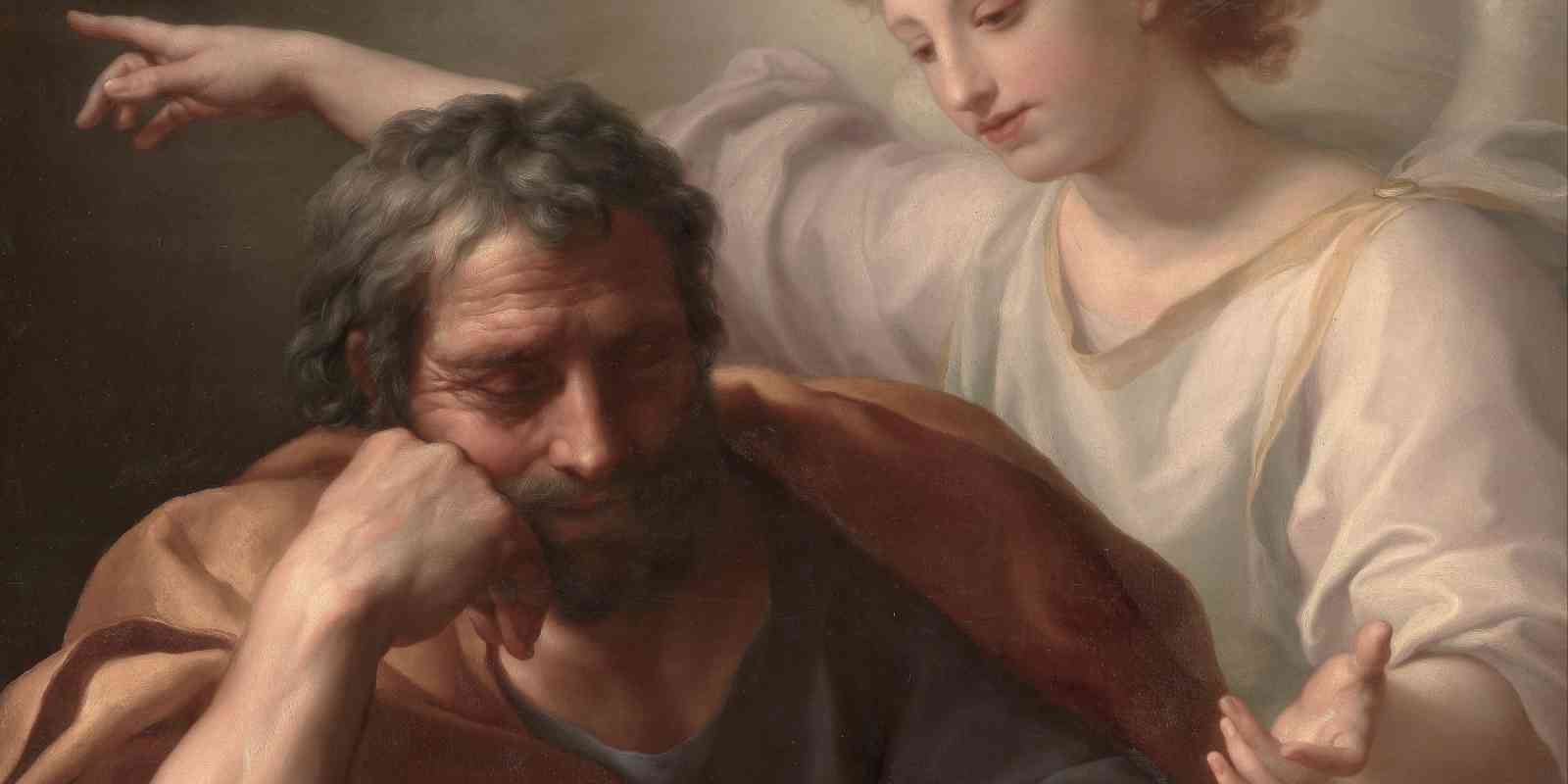
But on Sunday we hear the other Gospel fiat. St. Joseph gets his own annunciation, when the angel Gabriel tells him in a dream what Mary heard in the light of day:
“Do not be afraid to take Mary your wife into your home. For it is through the Holy Spirit that the child has been conceived in her … [H]e will save his people from their sins.”
How does Joseph react?
“When Joseph awoke, he did as the angel of the Lord had commanded him and took his wife into his home.”
He said nothing. He did exactly what he was told. This is his fiat of action — and it is the most common fiat required of us in life. Usually, what we are asked to do are small deeds that no one sees, the wordless fiat that doesn’t get noticed, much less celebrated.
Third: Learning to imitate Joseph’s fiat is necessary preparation for Christmas.
God has a very difficult job to do at Christmas. He wants to come close to his people, but his people no longer trust him. He wants to be Emmanuel, God With Us, but we’re convinced he is God Against Us.
This misunderstanding about God is at the heart of the fall of Adam and Eve. When Eve was faced with a serpent asking her to do the one thing God told her not to do, she easily fell into the traps he laid. First, he made God sound strict (“Did God really tell you not to eat from any of the trees in the garden?”). Then, he made God sound tricky (“God knows well that the moment you eat of it your eyes will be opened and you will be like gods.”) Once they ate, their whole attitude toward God changed. They no longer walked with him in the garden; they hid when they heard him approaching.
We have the same misunderstandings about God today. Either we feel he is irrational and negative and mean, and we know better, or we think he is dictatorial, all-powerful and angry, so we act like an abused dog around him, shrinking in fear.
In the First Reading, Ahaz, the evil king, suffers from both pathologies. He lives a life of disobedience, and when God commands Ahaz to ask for a sign, Ahaz refuses. “I will not ask! I will not tempt the Lord!” he says. The words sound very holy, but they amount to a big “No way, José” to God. He thinks he has God figured out.
How wrong he is. Listen to the sign Jesus gives Isaiah next: “The virgin shall conceive, and bear a son, and shall name him Emmanuel.” God is telling him that Mary’s fiat will reverse the “Us Without God” of the Fall. Not only is God not the dictatorial being Ahaz imagines and has no problem rebelling against — God is planning to be small, in order to ennoble us.
In the Gospel, Joseph has the reverse attitude of Ahaz. Obedient to God’s law, when he finds Mary is pregnant, he is willing to separate from her. But when the angel tells him the “the virgin has conceived” he is willing to do that instead.
Joseph is not too great to be God’s servant; he’s also not too “humble” to be God’s partner. He trusts God and is willing to learn from God who God is.
Fourth, compare Joseph’s sacrifice to Ahaz, and to Adam and Eve.
St. John Chrysostom’s commentary on the Joseph Gospel helps underline the greatness of Joseph.
Joseph sacrifices his understanding. The angel tells him that Mary conceived by the Holy Spirit — a mystery so great that Chrysostom says even the angel can’t explain it. “Do not speculate beyond the text,” he writes. “Shame on those who attempt to pry into the miracle of generation from on high! … Neither Gabriel nor Mathew was able to say anything more.” This is the first of many things Joseph will not understand — including the hard road to the birth, the harsh words of Simeon, the harrowing flight to Egypt, and the mysterious words of his son at the Finding in the Temple.
Joseph sacrifices his paternity. Chrysostom points out that Gabriel told John the Baptist’s father, Zechariah, that his wife would “bring forth to you a son.” Joseph’s wife will “bring forth a son,” but not to him. Think of how different these two situations are. It’s the difference between being told “Congratulations, you’re a dad!” vs. “Your wife’s pregnant, and you have to take care of the child.” But Joseph accepts.
Joseph sacrifices his pride. When the angel comes to him in a dream — not in a grand waking vision, like Mary had, but in his sleep — he accepts a new reality. He takes his celibate wife into his home, even though she is pregnant with a child that is not his. As St. John Chrysostom puts it, “Do you not see here a man of exceptional self-restraint, freed from the most tyrannical passion, jealousy?”
Fifth: St. Paul shows how fruitful Joseph’s fiat (and ours) can be.
The Second Reading this Sunday is Paul’s fiat — his loud and clear “Thy will be done” — from the beginning of his letter to the Romans, and it shares a lot in common with Joseph’s.
First, Paul calls himself a “slave of Christ Jesus,” comparing him to Jesus who took “the form of a slave” and was obedient unto death to save us. Then he spells out what his main task is: to bring about the “obedience of faith” as the first obligation of the Gospel for those of us who “belong to Jesus Christ” in the Gentile world.
But notice what he says about Jesus: He is the descendent of David promised by the prophets. How is he a descendent of David? Because he came from the marriage of Joseph, son of David, to Mary. This is the fruit of Joseph’s sacrifice: his foster son brought his family the ultimate glory.
In the same way, our fiat to God will bear fruit for his kingdom. Our fiat of deeds and our fiat of words come together in each Mass. We face Jesus Christ in the Eucharist and sacrifice understanding, seeing God in a host, though we don’t know how; sacrificing our authority, declaring that we belong to Christ, as does every member of our family, and sacrificing our pride, putting our will at the service of God’s will.
Above all this happens in the communion line, when the host is held before our eyes and called “The Body of Christ,” and we answer “Truly it is so! Let it be done” — or, in other words, “Fiat!”, “Amen.”
Image: Google Art Project
By Tom Hoopes
Dear Reader,

Would you like to better understand the spiritual depth and daily insights of Jesus' parables?
We'd like to offer you our FREE video series, Christ the Storyteller. Each episode of this series will help you experience the profound truths Jesus conveys in each parable.
In 10 short lectures, Dr. Andrew Swafford, Professor of Theology, dwells on a different parable—revealing their theological meaning, spiritual insight, and practical guidance for everyday Catholic living.
Start your FREE video series today and explore the practical wisdom of Jesus’ Parables!
Receive My Free Video Series »