This Sunday, the One Who Will Surprise Us Is Already Here


The Church puts us on high alert this Sunday, the First Sunday of Advent, Year A. It’s a celebration and anticipation and a caution, all in one.
Here are four takeaways for this Sunday drawn from Sunday Readings columns at this site and the Extraordinary Story podcast.
First: The Gospel warns that the Lord will surprise you in your daily life.
“Stay awake!” says Jesus. “You do not know on which day your Lord will come.”
Jesus is warning about the end of time in Sunday’s Gospel. We are used to assuming that this will happen in some dramatic way. But Jesus says it will happen in the most natural way possible. People will be “eating and drinking,” getting married, living their lives. “Two men will be out in the field; one will be taken, and one will be let. Two women will be grinding at the mill; one will be taken and one will be left.”
One person from your office will be taken, another left. One customer at the store will be saved; another will fail.
We are also used to assuming this will happen many years from now. But his warning could very well be about our own time. After all, St. Faustina heard Jesus tell her these words, early in the 20th century: “You will prepare the world for my final coming.”
Did he mean remote preparation, just as he did in the Gospel? Maybe. Or maybe not. What we do know, from Sunday’s readings, is that we will be surprised when Jesus comes again — and so we should live always as if it will happen at any moment.
Pope Benedict, commenting on today’s readings, said: “Man is the one creature free to say ‘Yes’ or ‘No’ to eternity, that is, to God. The human being is able to extinguish hope within him, eliminating God from his life.”
He means “from his daily life.” Living life with space for God or excluding him and keeping him out is something you do at all times; it’s something you are doing at this very moment.
Second; that means we do know the hour to be ready: it is right now.
“You know the time,” says St. Paul in the second reading. “It is the hour now for you to awake from sleep.”
To awake from sleep means to “Throw off the works of darkness and put on the armor of light.” He lists some of the works of darkness: “promiscuity and lust … rivalry and jealousy;” he says to “make no provision for the desires of the flesh.”
Preparing yourself for judgment requires a very deliberate effort — it means avoiding what leads you to sin and doing those things which “arm you with light” by “conducting ourselves properly as in the day.”
His advice here is the same as the advice Jesus gave in the sermon on the mount: “Let your light so shine before men, that they may see your good works and give glory to your Father who is in heaven,” he said.
The idea is that Christians should be different; “in the world not of it,” citizens of heaven living on earth. If that doesn’t describe you yet, that’s what Advent is for.
Third: The King of the Universe is making a visit to our humble homes.
St. Paul speaks in his letter to the Thessalonians about the “coming” of Christ, which in Latin is adventus, Advent. Pope Benedict XVI described it this way:
“In the language of the ancient world it was a technical term used to indicate the arrival of an official or the visit of the king or emperor to a province. … Christians used the word ‘advent’ to express their relationship with Jesus Christ: Jesus is the King who entered this poor ‘province’ called ‘earth’ to pay everyone a visit.”
The four weeks of Advent will describe various metaphors for the kinds of preparations we should be making to give Christ as royal a welcome as possible. But for the First Sunday of Advent, the readings stress one way we greet long-awaited visitors: We go out to meet them.
If Christ the King of Everything is coming, we should go out to meet him, as Isaiah describes in the First Reading:
“The Lord’s house shall be established as the highest mountain and raised above the hills. All nations shall stream toward it … O house of Jacob, come, let us walk in the light of the Lord!”
So we can think of Advent as our march toward a mountaintop experience with the Lord who is coming, a time to seek “the word of the Lord” and to “beat swords into ploughshares;” in other words to withdraw from the noisy habits of daily life and withdraw a little into his quiet through Scripture, prayer, and repurposing everything we can to the service of Christ.
In the novel Les Miserables, Victor Hugo describes the years Jean Valjean and Cossette are sheltering in a convent with words that are a beautiful description of what Advent can be. Valjean is working every day, just as he had all his life; but doing it in an atmosphere of prayer, dedicated to his foster daughter, transforms him into the person a good bishop had called him to be when he first repented of his sins.
“God has his own ways. The convent contributed, like Cosette, to confirm and complete, in Jean Valjean, the work of the bishop.
“Everything around him, this quite garden, these balmy and simple women, this silent cloister, gradually entered into all his being and, little by little, his soul subsided into silence like this cloister, into fragrance like these flowers, into peace like the garden, into simplicity like these women, into joy like these children. …His whole heart melted in gratitude, and he loved more and more.”
This is what we are meant to do in Advent: Repent, and in quiet and seriousness, build the life our repentance pointed us to. This is what Jesse Trees, Advent candles, yearend donations and holiday volunteering, are meant to do; along with, above all, Advent Mass.
Fourth: The Advent season is a Marian season, with Mass at its center.
There is one person who is an exemplar of being ready for Jesus at all times, and for living a life centered on Jesus Christ: Mary.
Advent is filled with references to the Blessed Mother: There is the feast of the Immaculate Conception, celebrating Mary, conceived without sin, and the feast of Our Lady of Guadalupe featuring Our Lady, pregnant, greeting Juan Diego. These feasts invite us to think of Advent preparation not just like preparing for a visiting dignitary, but like preparing for a new baby who is already within us.
That is a truth not just for Mary in the days leading up to Bethlehem, but for us, before Christmas, as well. Pope Benedict XVI stressed that adventus, Advent, doesn’t just mean “God will come in the future;” it also means:
“God is here, he has not withdrawn from the world, he has not deserted us. Even if we cannot see and touch him as we can tangible realities, he is here and comes to visit us in many ways.”
Mary experienced this in her pregnancy; we experience it in the Eucharist. Jesus and his kingdom is the reality that is “already … but not yet.” He is here, among us, in his body, blood, soul and divinity; and his real presence is powerful and transformative. But he is not yet here in his fullness and finality.
So we prepare for his coming like Mary did in her daily life in Nazareth, and like the people at the end of time on the journey to Mount Zion. We prepare for God with God, and for Jesus Christ with Jesus Christ.
And we do it for our sake and for the sake of our neighbors, who long for the light that we have found, if only we will show it to them.
“God is the future of the human person and of the world,” St. John Paul II said of this Sunday’s readings. “If humanity loses the meaning of God, it will close itself to the future. … Christ is the hope of humanity. He is the true meaning of our present, because he is our sure future.”
What are we waiting for? Baby Jesus is coming at Christmas, but Jesus the judge is coming also. When he does come he will look us each in the eye, and see into our souls. He made us; he loves us; he wants us with him; and he wants us to welcome him, starting today.
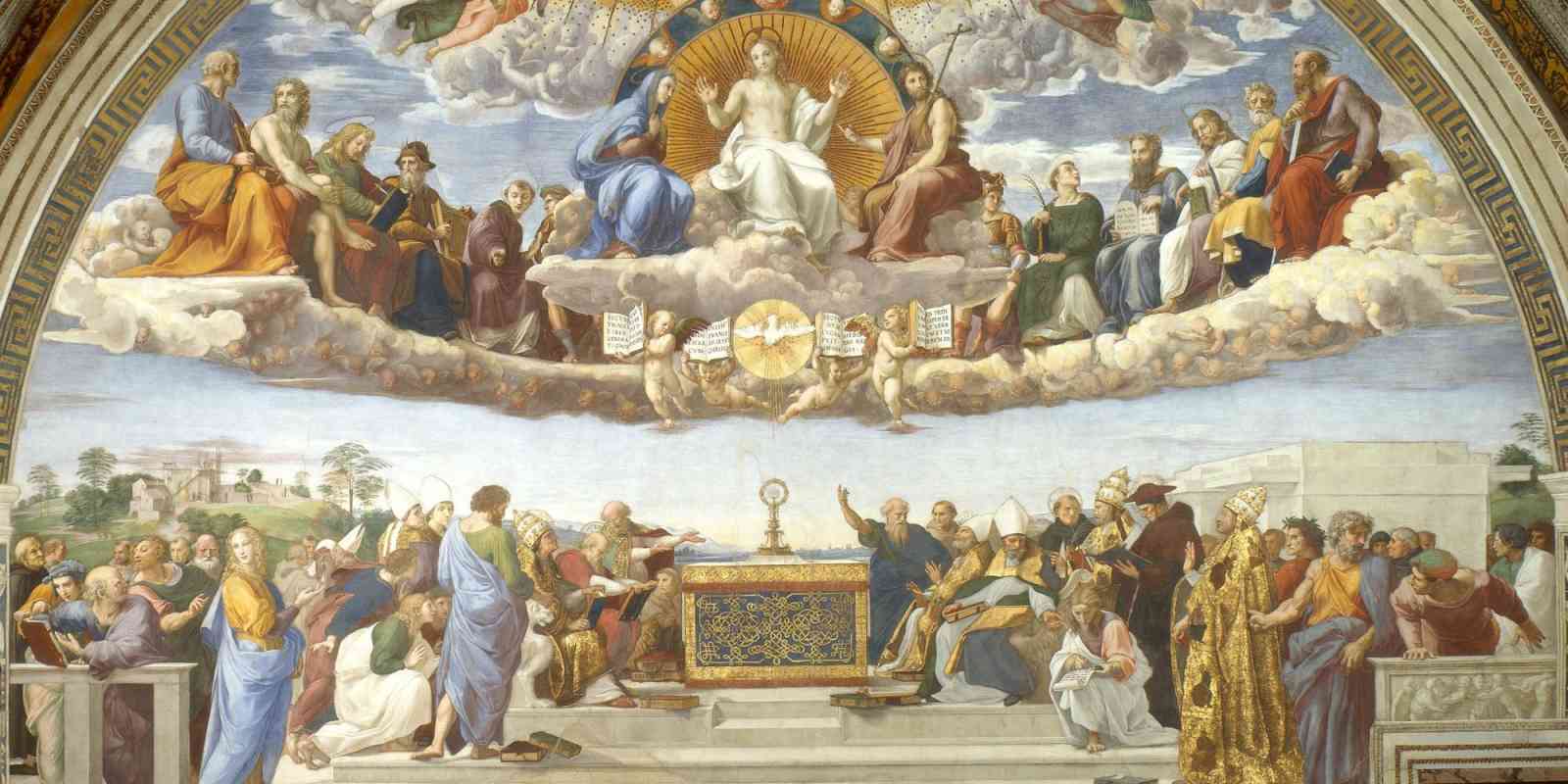
Image: Wikimedia
By Tom Hoopes
Dear Reader,

Would you like to better understand the spiritual depth and daily insights of Jesus' parables?
We'd like to offer you our FREE video series, Christ the Storyteller. Each episode of this series will help you experience the profound truths Jesus conveys in each parable.
In 10 short lectures, Dr. Andrew Swafford, Professor of Theology, dwells on a different parable—revealing their theological meaning, spiritual insight, and practical guidance for everyday Catholic living.
Start your FREE video series today and explore the practical wisdom of Jesus’ Parables!
Receive My Free Video Series »