What Francis Did: How Will the Pope Be Remembered?


How will Pope Francis be remembered?
Pope Francis, 88, leader of the world’s more than one billion Catholics, died this morning at 7:35 a.m., after a brief rally from a long period of illness that began with a severe respiratory infection. Many things come next: a papal funeral, a conclave, and the announcement of a new Pope.
But the question of the Argentinian pope’s legacy will linger long after the mourners have left St. Peter’s Square, long after the pageantry of the papal funeral, and long after his successor is no longer new.
It is also a question that we probably will not see answered in our lifetime. For a Church that thinks in millennia, the impact of a single Pope is usually smaller than our exaggerated viewpoint expects. But it is interesting to speculate nonetheless.
Believe it or not Pope Francis might be remembered as the Pope who defended the faith.
His interview on 60 Minutes last year was an eye opener for many Americans, because it was how they learned where he stood all along, which is something readers of my book What Pope Francis Really Said already knew.
Where he stood was right in line with the Church, and the reason people were surprised was that Pope Francis said controversial things throughout his pontificate, but the context was often ignored by both the mainstream and religious media.
Yes, last year he said “All religions are paths to God. I will use an analogy, they are like different languages that express the divine.” But, no, he did not say that all religions are equally true.
And yes, he said things that were easily taken the wrong way throughout his pontificate. But even in his first year as Pope, the evidence was there that the communist accusations by Rush Limbaugh, Rod Dreher and the Drudge Report were misplaced.
Yes, he was focused on climate change, like John Paul II and Benedict XVI before him. His encyclical on the environment was an “awesome, irksome mess”: a beautiful restatement of core truths — and a self-contradictory embrace of environmental fads. But that encyclical, and his magisterium generally, when all is said and done, was in favor of free enterprise.
In fact, Pope Francis defended the most distinct and controversial teachings of the Catholic Church.
- Birth Control. Pope Francis continued the ages old Catholic tradition recognizing the immorality of artificial contraception.
- Same-sex attraction. Pope Francis affirmed both parts of the Church’s teaching about homosexuality: The moral depravity of homosexual acts, and the respect due to people who are same-sex attracted.
- Remarriage and confession. Pope Francis upset many theologians by his references to divorce, remarriage and confession in his encyclical Amoris Laetitia. But a longtime hand in the Vatican told me I was right when I speculated that what he really wanted was sacramental confession for these Catholics.
He may be remembered as the Pope who saw the deep needs in the hearts of 21st century men and women.
The truth is, for someone who seemed disconnected from popular culture and even recent theological developments, Pope Francis did see what ails us.
- Technology and consumerism. Pope Francis saw the depths of evil in our 21st century sins of consumerism and technocratic obsession.
- Evangelization. Pope Francis described how, and why, Catholics should evangelize every day.
- The need for community. Pope Francis also identified the chief issue at the heart of many 21st century maladies: Social isolation and loneliness.
He had a beautiful personal touch, whether it was kissing babies or trading hats with newlyweds. It was all part of his personal witness to Catholics today.
In fact, Pope Francis might be remembered as the Pope who finally convinced many Catholics to serve.
Catholic theologian and popular author Ralph Martin said at a conference on Pope Francis that in all his years of apologetics and evangelization he had done only limited service work. Until Francis.
“Now my wife and I have begun work with the St. Vincent de Paul Society and found it immensely rewarding,” he said.
Intellectually, he always knew he was supposed to serve the poor, he said. Pope John Paul II and Pope Benedict told Catholics to do it, too. But Pope Francis — somehow — moved his will to do it.
I was so struck by what he said that I began to ask Catholics whether or not they had the same experience. Again and again, I heard that they had.
For Francis fans and Francis detractors, for Vatican watchers and people who don’t follow Church news; for daily communicants and Sunday Catholics, it was the same: Francis had convinced them to change their lives in small ways and large. Some volunteered at service organizations, some instituted environmental practices, some felt more confident about sharing their faith. Why?
Because Francis’s lifestyle was different — and his words were different. Which brings up a second way Francis might be remembered.
Francis might be remembered as the Pope who made the Church seem relevant again to many who had written it off.
Of course, the Church never stopped being relevant. But something happened over the last decades of the 20th century and the first decades of the 21st: The world stopped taking us seriously.
The Church used to be a force to be reckoned with. We were worth loving or hating; we were worth defending or attacking. People cared passionately about what we believed.
But that had all changed by the turn of the last century. St. John Paul II started it. He was loved and respected and admired — and he left the Church far more robust than he found it. But he left behind more “reverts” than converts. John Paul, and Benedict after him, transformed the culture of the Church in the West, but not the culture of the West.
The content of Francis’s message was basically the same as theirs, but he communicated it with urgency and novelty. Popes since Pius XII have allowed for evolution; but Francis made headlines by saying God is “not a magician.” Popes have always championed the poor against moneyed interests; Francis excoriated “idolaters” fascinated by the “Devil’s dung.” Popes have always visited prisons; Francis did it on Holy Thursday and washed their feet — with cameras present.
To use common parlance, Pope Francis’s message “broke through,” even on questions the Church considered settled. Which brings up a third way he might be remembered.
Francis’s might be remembered as a papacy with surprising reach.
Pope Francis, for years, has been compared with John XXIII. They were both 76 when they were elected. Both were expected to have brief papacies that got little accomplished. Both surprised everyone by tackling huge “pastoral” issues — one with a council, the other with synods and a flurry of activity.
But there is a fine line between “addressing longstanding pastoral problems” and “opening cans of worms.”
The successor of Francis will decide where his surprising reach became overreach.
If Pope Francis had his wish, he would be remembered for the culture of encounter.
Pope Francis was elected on the force of a brief speech he gave to cardinals in a pre-conclave meeting, in which he said the next pope should lead the Church out to the peripheries to seek the forgotten and the lost.
“Put simply, there are two images of the Church,” he said. There is the “Church which evangelizes and comes out of herself … and the worldly Church, living within herself, of herself, for herself.”
Whatever else can be said about the pontificate of Pope Francis, he did his part to build that second Church. He later described it this way:
“Instead of being just a Church that welcomes and receives by keeping the doors open, let us try also to be a church that finds new roads, that is able to step outside itself and go to those who do not attend Mass, to those who have quit or are indifferent.”
This is exactly what he did, with his words and with his actions.
The whirlwind that was Pope Francis has quieted now — but he has left our landscape changed.
The Catholic Herald printed portions of this
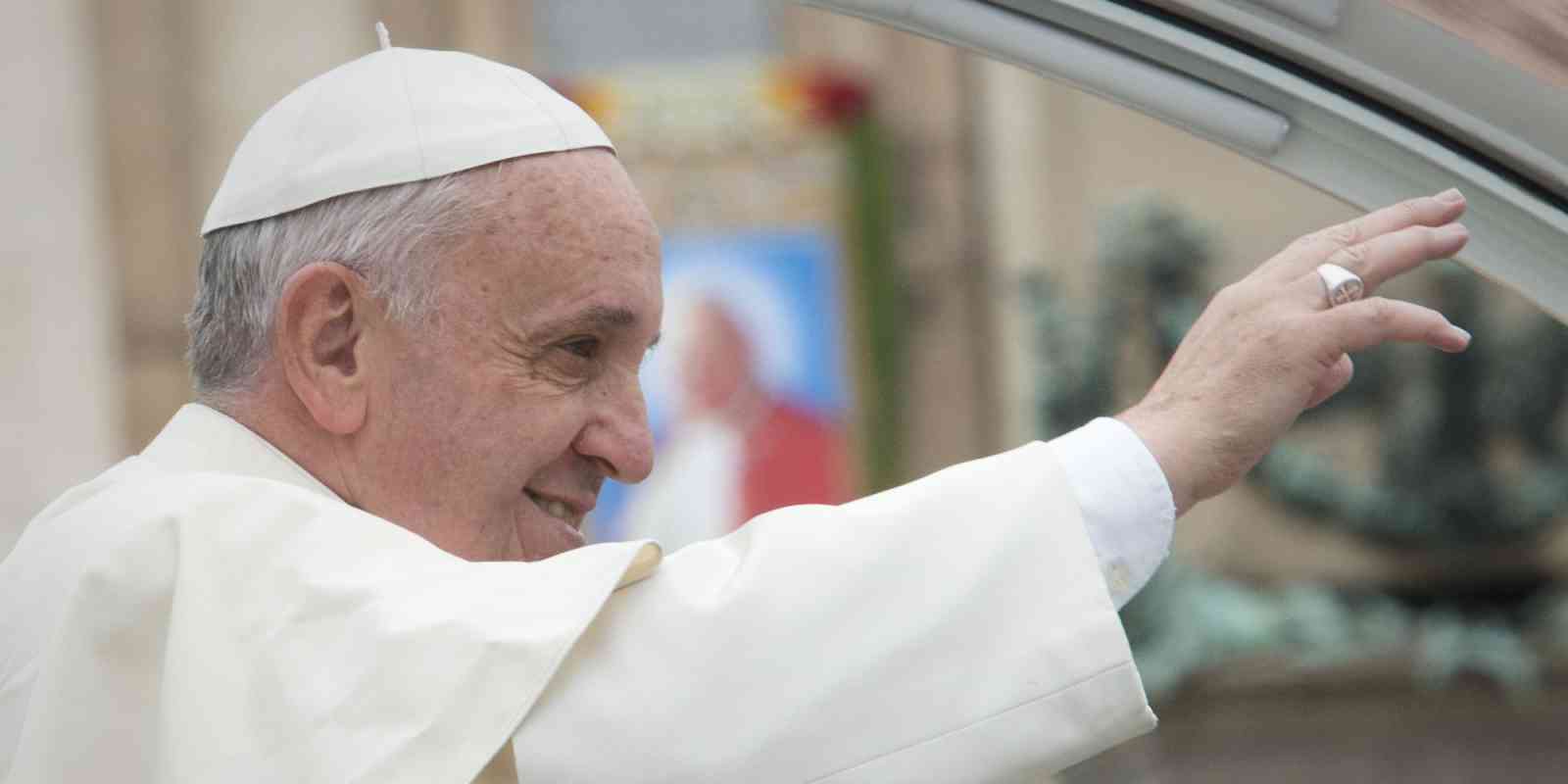
Image: Wikimedia Creative Commons,
Jeffrey Bruno from New York City.
By Tom Hoopes
Dear Reader,

Would you like to better understand the spiritual depth and daily insights of Jesus' parables?
We'd like to offer you our FREE video series, Christ the Storyteller. Each episode of this series will help you experience the profound truths Jesus conveys in each parable.
In 10 short lectures, Dr. Andrew Swafford, Professor of Theology, dwells on a different parable—revealing their theological meaning, spiritual insight, and practical guidance for everyday Catholic living.
Start your FREE video series today and explore the practical wisdom of Jesus’ Parables!
Receive My Free Video Series »