


This Sunday, Jesus Answers Our Doubt by Leaving Us in Charge


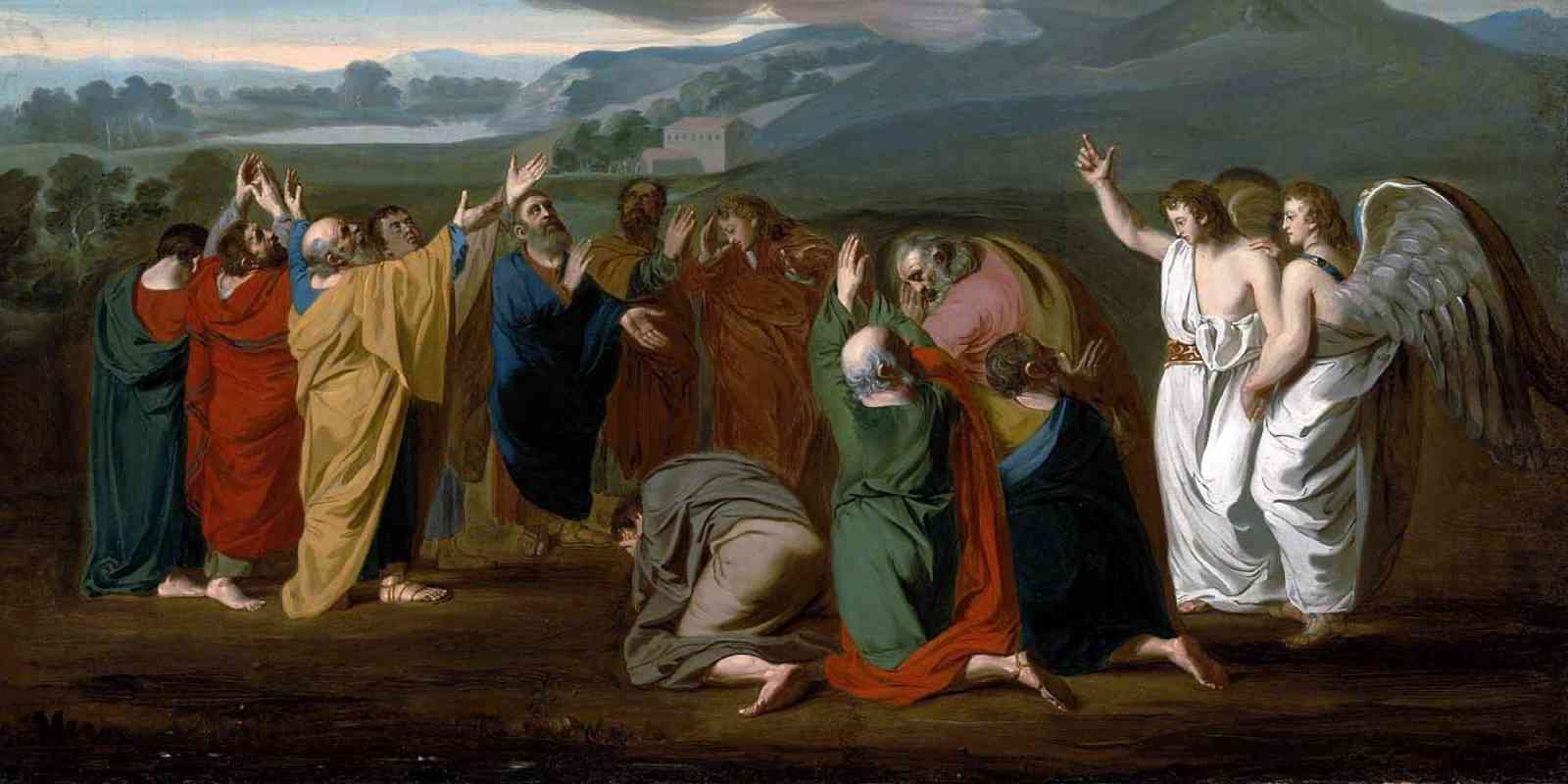
By Ascending into heaven, Jesus shows us how he handles our doubt this Sunday, the Seventh Sunday of Easter – Ascension Year A. He doesn’t answer every question we have: Instead, he puts us in charge of answering everyone else’s questions.
Here are four takeaways for this Sunday’s readings, drawn from Sunday Readings columns at this site and the Extraordinary Story podcast.
First: Pay close attention to what Jesus says in the Great Commission.
One of the big lessons writers learn about drama is show, don’t tell. When the Apostles gather on the mountain “they worshiped, but they doubted.” So Jesus demonstrates who he is by his actions and instructions. Consider what he says:
— First: “All power in heaven and on earth has been given to me.”
Here, Jesus reaffirms that he is indeed divine, and obliquely references the Trinity. Who is the only possible giver of all power on earth? God alone. And who is the only possible receiver of all power on heaven and earth? Again, only God. On the night before he died, they had heard him pray, “Now glorify me, Father, with you, with the glory that I had with you before the world began.” That prayer is now answered.
— Next, he instructs: “Go, therefore, and make disciples of all nations …”
His command here changes everything about world history, but does it subtly. Jesus tells them to gather all families and all peoples — all races, creeds, and social classes — to follow him. That moves humanity from being concerned only with our own clans and tribes to committing us to love for the members of every clan and tribe.
— He specifies: “Baptizing them in the name of the Father, and of the Son and of the Holy Spirit …”
Here, Jesus reaffirms that the sacraments are crucial to Christianity. He isn’t starting a religion, but a relationship; he is establishing a new family that unites human beings with the Triune God. This fulfills another prayer he made to the Father: “They are yours, and everything of mine is yours and everything of yours is mine, and I have been glorified in them.”
— He continues: “… teaching them to observe all that I have commanded you.”
That “all” is important here. Jesus is disqualifying cafeteria Christianity that picks and chooses what we believe. He wants his followers to live all his teachings about faith and morals, whether they are easy or difficult, or whether they match our political preferences or not. And he created a Church to perpetuate them. As he prayed to the Father the night before he died, “the words you gave to me I have given to them.”
His final, supreme act of show, don’t tell, happens when he is taken up, leaving them alone on a mountaintop.
Second: The apostles’ confused reaction is a great spiritual lesson about who we are.
Don’t forget that the Ascension is an answer to the apostles’ doubt. They had met Jesus, who rose from the dead and “presented himself alive to them by many proofs,” and had told them to wait for “the promise of the Father about which you have heard me speak.”
They knew exactly what Jesus wanted from them. He had told them that each must be persecuted, and each must “take up his cross and follow me” and “deny yourself.”
Their job was to “let their light shine before all people,” and “be reconciled to one another.” He commanded them to “seek first his kingdom and his righteousness,” and “love your neighbor as yourself.”
But now they expect the kingdom to be handed to them for nothing, asking, “Lord, are you at this time going to restore the kingdom to Israel?”
No, he answers; they will restore the kingdom: “You will receive power when the Holy spirit comes upon you, and you will be my witnesses … to the ends of the earth.”
Then, when “He was lifted up, and a cloud took him from their sight,” they just stand there, dumbfounded — suddenly alone and uncertain. Angels ask, “Men of Galilee, why are you looking at the sky?”
As they stand looking up at the sky that they are uncomfortably like us. They gathered on a mountain; we gather in a church. They saw Jesus do mighty deeds in their midst; we have seen him transform our lives with the sacrament and his body, the Church, do mighty deeds in history.
But we look at the world and see a place where the bad guys are winning in one way or another everywhere. Shadows overwhelm the light and indifference smothers the love of Christ. Righteousness doesn’t reign. We feel disappointed by our families, compromised by the world, and hurt by the Church.
But Jesus gave them their marching orders, and he gives us ours: We are in charge of his kingdom now. And we won’t build it by looking at the sky, contemplating our own hurts and confusion.
Third: The hurt and confusion is part of the plan.
If hurts for the disciples to see the world in a bad place, and no one but themselves in charge. That’s good. It should hurt. The uncomfortable absence of Jesus as they knew him was necessary for the apostles to embrace the Holy Spirit and be transformed.
St. John Chrysostom points out the psychological benefit of Jesus leaving the way he does in the Ascension. He asks: “Why did the Holy Spirit not come to them while Christ was present, rather than immediately after his departure?” His answer: “It was necessary for them to have a longing for the event, and so receive the grace.” Then, he adds:
“Our desire toward God is most awakened when we stand in need. … If Christ had then departed when the Spirit had already come, and the Spirit remained, the consolation would not have been so great as it was.”
Our confusion, pain, and longing is meant to lead to study, self-sacrifice, and prayer; and our study, self-sacrifice, and prayer is meant to open us to the coming of the Holy Spirit. The coming of the Holy Spirit is meant to compel us to share the reason for our hope with a world that desperately needs answers.
The angel offers one more reminder to help prod the apostles move forward. “This Jesus who has been taken up from you into heaven will return in the same way as you have seen him going into heaven,” he says.
The lesson is clear. They had heard from Jesus himself how he will return: As judge of “all the nations,” separating the sheep from the goats. Now, Jesus just put them in charge of preparing all the nations. When he comes to judge he will want to see how we have done.
Fourth: But don’t forget the last thing Jesus says at the Ascension.
Before being taken up, Jesus has one final message to the Apostles, and to us: “Behold, I am with you always, until the end of the age.”
This is a beautiful reference to the Eucharist. All of his admonitions on the night before he died led to the Institution of the Blessed Sacrament, and when he appeared to the Emmaus disciples and they asked him to stay, he broke bread and disappeared, showing them that this is how he would stay. This is repeated at every Mass, where we don’t simply wait for Jesus, we receive him now, in his body, blood, soul and divinity.
In these days between the Ascension and Pentecost, we pray to receive the Holy Spirit with the same openness. He will appear at Pentecost like a fire and a wind. Preparing for the Holy Spirit means opening up the dark, hidden places of our heart to the healing rays and fresh air of God.
If resentment has been festering in our heart toward one person, or institution, or another, he comes to heal that. If we have failed to increase our study, sacrifice, or prayer, he comes to inspire that. Fresh air and sunlight are the best disinfectant for scrapes and cuts; the wind and fire of the Holy Spirit is the best way to repair our wounded hearts and souls.
Lent and Easter offer a great time to start again. So will Pentecost, when we will welcome the Holy Spirit into our lives anew.
By Tom Hoopes
Dear Reader,

Would you like to better understand the spiritual depth and daily insights of Jesus' parables?
We'd like to offer you our FREE video series, Christ the Storyteller. Each episode of this series will help you experience the profound truths Jesus conveys in each parable.
In 10 short lectures, Dr. Andrew Swafford, Professor of Theology, dwells on a different parable—revealing their theological meaning, spiritual insight, and practical guidance for everyday Catholic living.
Start your FREE video series today and explore the practical wisdom of Jesus’ Parables!
Receive My Free Video Series »


